
Author: Dr. Andreas Kokott (About the Author)
In another blog post, we already explained why it is important to match the wick treatment to the type of wax being used. Therefore, we can assume that every beekeeper needs wicks designed for beeswax rather than paraffin wax. Likewise, other candle makers need wicks that are suitable for the specific wax they use.
This article is about choosing the correct wick size. Wick numbering is not standardized. This means that a wick sold as No. 3 in our range may be labeled No. 2 or No. 5 by another supplier.
TIP: When purchasing wicks, specify the type of wax and the desired candle diameter. This makes it much easier to select the correct wick.
When using natural waxes, wax purity also plays an important role. If beeswax is not thoroughly purified, you can often reduce burning problems by choosing a wick that is one or two sizes larger. However, it is always best to use well-purified beeswax. If the purity of the wax varies, candles will burn differently. This leads to inconsistent results, disappoints customers, and reflects poorly on product quality.
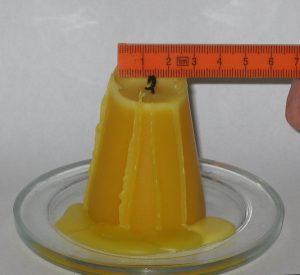
A good supplier tests their wicks and provides recommendation charts based on candle diameter. If you are using an unknown wick, you can also perform a simple test with a cone-shaped candle.
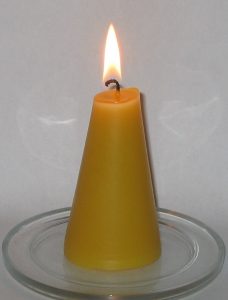
The illustration shows the maximum diameter at which a candle burns completely without leaving a rim of unmelted wax. If a rim does form, extinguish the flame and measure the diameter of the melted “crater.” This measurement represents the maximum candle diameter suitable for that wick. Keep in mind that this result applies only to the specific wax and the ambient temperature conditions under which the test was carried out. Therefore, slight variations in the recommended diameter are normal.
Because heat spreads evenly around a flame in a circular pattern, the ideal candle shape is a cylindrical candle with a round cross-section.
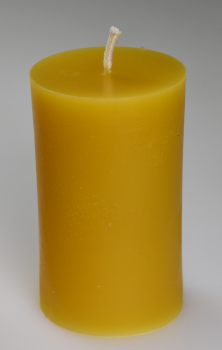
If a candle shape is not perfectly symmetrical but is approximately round—for example, a Christmas tree—you should choose a wick that is still capable of melting the wax at the candle’s widest point (see illustration, G and K).
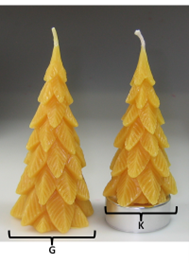
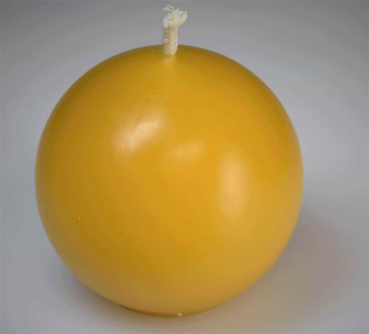
If the candle has its greatest diameter in the middle, choose the wick according to this maximum diameter. A sphere, for example, has its largest diameter at its center.
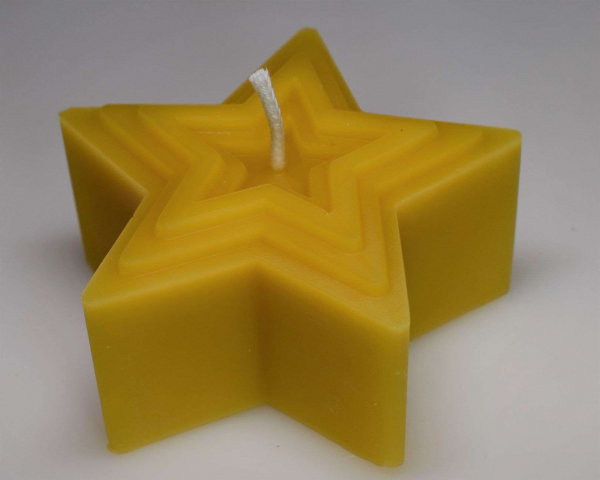
For all other geometries, such as star-shaped candles, finding the ideal wick is always a challenge. If the wick is too small, it will tunnel down through the candle. If the wick is slightly larger, melted wax will run off over the points. As a result, candles with these shapes will always leave a considerable amount of unburned wax.