

Which Dowsing Rod Is Right for You?
Dowsing Rods: Types, Uses, and the Best Rod for Beginners
Author und Editor: Dr. Andreas Kokott (About the Author)
It’s important to start with the right dowsing rod. Over the years, I have tested a variety of dowsing rods and pendulums. If you’re new to dowsing, it’s best to begin with a rod that delivers quick, clear responses. Building confidence with an easy-to-use dowsing rod makes the learning process much smoother. Once you’ve gained experience, you can explore and work with other types of dowsing rods.
I’d like to introduce the dowsing rods that I personally use and recommend in my courses and training materials.
The Classic Y-Rod
Most people have seen pictures of someone using a forked tree branch as a dowsing rod. This traditional Y-shaped rod is easy to make because all you need is a flexible forked branch. Modern versions are also available in metal or plastic.
Personally, I do not work very well with a Y-rod. It is rarely used indoors but is well suited for surveying land and larger outdoor areas because it allows you to walk comfortably while dowsing.
One-Handed Dowsing Rod
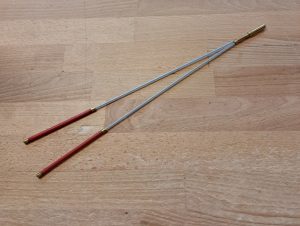
When I first started using a one-handed dowsing rod, I found it quite difficult. The responses were very subtle and easy to miss. However, once you become familiar with it, it is easy to use. Interestingly, the same skill transfers to pendulum dowsing. If you can use a one-handed dowsing rod, you can usually use a pendulum as well—and vice versa.
Interestingly, the same skill transfers to pendulum dowsing. If you can use a one-handed dowsing rod, you can usually use a pendulum as well—and vice versa.
A one-handed rod is suitable for slow, precise work, but it is not the best choice for surveying large areas of land. Whenever I can walk through an area, I prefer using L-rods. For checking a bed, testing food sensitivities, or examining textiles, I recommend using a one-handed dowsing rod or a pendulum.
Pendulum
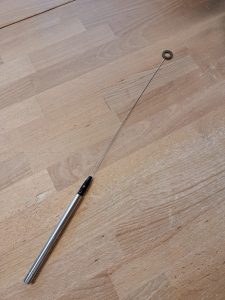
Strictly speaking, a pendulum is not a dowsing rod. However, I have included it here for the sake of completeness because it is an important dowsing tool. A pendulum is a small weight suspended from a string or chain. It can also be used as an alternative to a one-handed dowsing rod. Once you know how to work with a pendulum, you can use many different objects for dowsing. I once saw someone using a bunch of keys hanging from a chain as a pendulum. The weight of the pendulum is an important factor. Therefore, beginners should start with pendulums that are specifically designed for this purpose. Pendulums that are too heavy usually produce only very small movements, which can make dowsing more difficult for beginners.
L-Rods
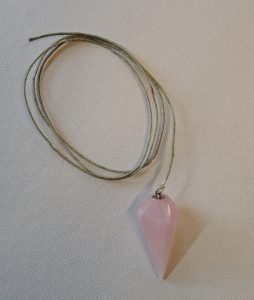
L-rods are an excellent choice for beginners. Like the traditional Y-rod, they allow you to walk comfortably over longer distances while dowsing. This would be much slower with a pendulum. L-rods are always used in pairs and are usually made of metal. Some models have rotating handles with bearings, but I simply use standard L-rods. My rods can be unscrewed, making them easier to transport and ship.
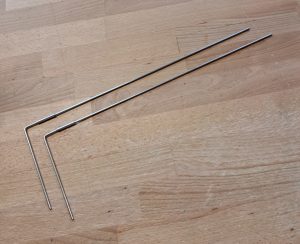
Which Dowsing Rod Should You Start With?
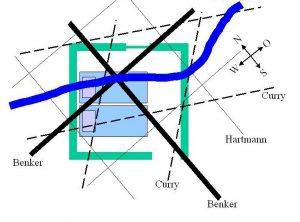
In my experience, L-rods are the best choice for beginners. They make it easy to locate Hartmann grids, Curry grids, underground water veins, and other earth energies with relatively little practice.
A Y-rod is another option, although I personally find it less precise.
Once you have gained some experience, you can move on to a one-handed dowsing rod or a pendulum. These tools are ideal for examining a sleeping area, a workspace, or performing measurements on the human body.
Over time, many dowsers build a collection of different tools and choose the most suitable one for each task.
L-Rods / Y-Rod: Best for surveying land and outdoor areas.
One-Handed Dowsing Rod / Pendulum: Best for indoor work, short distances, and examinations involving people.
Why Does Dowsing Work?
No one knows for certain how dowsing works. Existing explanations are incomplete.
One common theory is based on subtle muscle reactions. Imagine holding your arm straight out while carrying an object. Your muscles keep the arm raised. If those muscles lose a small amount of tension, your arm naturally drops. According to this theory, subtle energy changes influence the muscles, causing the dowsing rod to move when, for example, you walk over an underground water vein.
However, this explanation has significant limitations. These so-called energies cannot be measured using conventional scientific methods.
For example, if I walk across a field while concentrating on underground water veins, my dowsing rods respond. But if I focus instead on searching for a gold deposit, I can walk across the same water vein without any reaction from the rods.
For example, if I walk across a field while concentrating on underground water veins, my dowsing rods respond. But if I focus instead on searching for a gold deposit, I can walk across the same water vein without any reaction from the rods.
If muscle movements were caused solely by an external physical force, the response should not depend on what I am consciously searching for. This suggests that the process is more complex than current theories can explain.
I prefer to be open about this: we simply do not know exactly what happens during dowsing.
A similar situation exists in acupuncture. Traditional Chinese Medicine describes energy pathways, known as meridians, that cannot be directly identified as nerves or other anatomical structures. Although acupuncture has been extensively studied, many aspects of how it works are still the subject of scientific debate.
Dowsing is not an exact science—but it is fascinating, and above all, it is enjoyable.