
Author: Dr. Andreas Kokott (About the Author)
How I Discovered Backyard Beekeeping
At first, I have to admit that I was quite wary of bees. I grew up in a small town in a six-family apartment building. Later, my parents bought a farmhouse with about 5,000 square metres of land, including a small pond, in a very rural area surrounded by forests and fields. Out of boredom, my mother became interested in beekeeping.
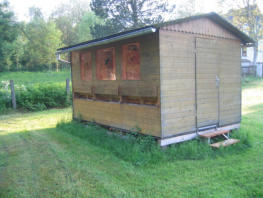
During the winter, my father and I built a bee house with space for twelve colonies. A bee house has the advantage that you can work with your bees regardless of the weather, and it also provides plenty of storage space for beekeeping equipment.
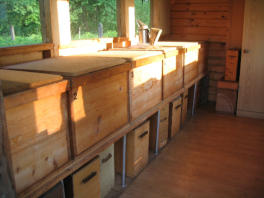
My mother joined a local beekeeping association and was assigned a mentor whom she could turn to whenever she had questions. We adopted his hive system, the Golz hive. There was also a beekeeping school nearby, which my mother attended.
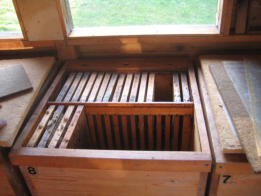
The Golz hive suited my mother very well because there is no need to lift heavy honey supers. The brood chamber is located at the front of the hive, while the honey chamber is at the rear. Both sections can be opened independently. At that time, we kept Carnica bees, which were the most common honey bee strain in our region.
I gained my first practical experience during my university holidays. I helped with extracting honey and inspecting the combs. As I mentioned before, I was still rather suspicious of bees. One day I helped retrieve a swarm that had settled in a tree. My father stood on the ladder while I held it from below. People always said that swarming bees do not sting because they have no hive to defend. Apparently, nobody had explained that to the bees. I had already been stung once or twice before, but this time I was stung several times on each ankle.
After graduating from university, I found a job close to my parents’ home, so I became more and more involved in the apiary. From time to time, my parents welcomed school classes that wanted to visit a working apiary. Preparing these visits took quite a bit of effort because we always wanted to extract at least some honey during the visit. Watching the honey extractor in action was the main attraction.
Visits by school classes always involve a certain level of risk because someone could have an allergic reaction to a bee sting. During one discussion, someone asked why we didn’t make beeswax candles.
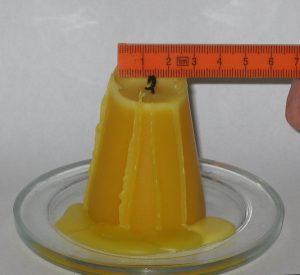
That simple question led us to explore beeswax candle making. We bought different moulds and experimented with them. I am a chemist and had previously worked on a research project involving silicone materials, so making our own moulds was not difficult for me.
My father enjoyed inventing and improving things. Together, we developed a mould for tealight candles, which we later registered for legal protection. From the very beginning, we cut our moulds open only as much as necessary to remove the finished candle. We threaded the wick using a long needle. That was how our company, Kerzenidee, came into being.
From Carnica to Buckfast
About 50 metres from our apiary, we have two neighbours who also keep bees. We have always placed great importance on gentle colonies. Unfortunately, our neighbours’ bees repeatedly robbed our colonies.
Through our company, Kerzenidee, we also came into contact with professional beekeepers. Most of them keep Buckfast bees. Buckfast colonies build up more strongly and start foraging earlier in the morning, even when the temperature is still too low for Carnica bees. They also produce higher honey yields. However, that was never the main reason for us. Beekeeping is a hobby for us.
Eventually, we also switched to Buckfast bees. Because their colonies are stronger, the losses caused by robbing from our neighbours’ bees became much smaller. At first, we kept Buckfast alongside Carnica. Today, we keep only Buckfast bees.
The “Bee War”
Although we were not the first beekeepers in our region to keep Buckfast bees, we were strongly opposed by a breeder of pure Carnica bees. His apiary was about 15 kilometres away. We believe he was concerned that our drones might affect his breeding lines and reduce his queen sales.
As a result, together with other Buckfast beekeepers in the region, we founded a local Buckfast group. Today, Buckfast beekeepers are accepted in our area, and more and more beekeepers are switching to Buckfast.
Bee House or Outdoor Apiaries?
After my father passed away in 2022, I had to reduce the number of colonies I kept. Even so, I remained closely involved with beekeeping. I continued talking with experienced hobby and professional beekeepers, and from time to time I obtained new nucleus colonies. As a result, my colonies became stronger because I was also receiving excellent new queens.
Today, my beekeeping operation looks like this:
Buying a figurine or mold does not automatically grant permission to reproduce it. The important question is whether the necessary rights for the intended commercial use have been obtained.Anyone who produces and sells candles, figurines, or other handmade products commercially should make sure to use only their own designs or legally authorized molds.
In the bee house, I keep smaller colonies, most of them still with a higher proportion of Carnica genetics, in the old Golz hives (German Normal Frame, vertical format—a rare hive size with 16 frames in the brood chamber and another 16 frames in the honey chamber). The disadvantage of this system is that inspecting the frames is time-consuming.
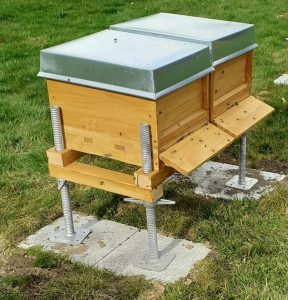
Later, I bought new hives for outdoor apiaries. Unfortunately, I chose Zander hives, which are common in my region. After one year, I switched to Dadant hives. With the Dadant system, hive inspections are much faster, and the larger hive suits the stronger Buckfast colonies better.
The disadvantage of both Zander and Dadant hives is that the honey supers are stacked on top of the brood chamber. A full super is heavy, so I use half-depth supers, which are much easier to carry.
I also appreciate using a bee escape. In a Golz hive, the queen excluder is installed vertically, which makes it possible to use a bee escape during honey harvesting.
At present, I keep about six Buckfast colonies in outdoor apiaries as a hobby. Occasionally, I also keep two or three Carnica swarms, which are housed in the bee house.
Experiences
Backyard beekeeping
Being able to see your colonies from the terrace is a real advantage. You do not have long distances to travel. All tools and equipment are stored in the house and are therefore close to the hives. The distance to the honey extractor is short, and you can always keep an eye on your colonies.
Honey bee colonies are valuable and are sometimes stolen. Unfortunately, vandalism also occurs. If the bees are kept in the garden, you have better control over them.
Bees races / Bee breeds
We switched to Buckfast bees. The majority of professional beekeepers I know keep Buckfast bees. The colony strength and honey yield are better compared to Carnica bees. Why should a hobby beekeeper not use the same breed that professionals use?
Over time, I learned that calm and patience are among the most important tools a beekeeper can have.
I have a stressful profession. One thing I have learned from other beekeepers is the importance of working calmly with bees. Bees notice immediately when you are restless or nervous.
A Bee Lesson Written on My Trousers – A Quick Inspection? The Bees Disagreed
I experienced this myself when I wanted to quickly check my bees one more time. Unfortunately, my bee suit was not completely closed around the neck. When I opened the hive, several bees crawled inside the protective suit. They had their weapons with them. After a few stings, the others came to help.
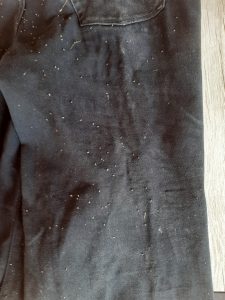
I still put the hive back together, but I received quite a number of stings. The small white dots on my trousers (photo below) —the venom sacs attached to the stingers—showed how defensive a bee colony can become. These things can happen in beekeeping.
What I appreciate most about bees and beekeeping:
Bees force me to slow down. The theory behind bees is fascinating. There is still so much we do not know. Beekeeping is a contribution to nature. Every year of beekeeping is different.
Future Challenges for Beekeeping
Climate change affects plants and therefore also has an impact on bees. The Asian hornet is now only a few hundred kilometres away from us. Wherever it appears, it causes damage to honey bee colonies.
In addition, beekeeping businesses are facing economic pressure from cheap imported honey and adulterated honey.
There is only one solution: beekeepers need to become more diversified by focusing on:
Building a customer base that values quality and local products.
Offering additional high-quality products such as cosmetics, candles, propolis, and other bee-related products.
Turning beekeepers into regional brands. This can only be achieved with business knowledge.
Comprehensive business knowledge
Tapiko Academy
Im Laufe der Jahre hat meine Reise mit den Bienen viele verschiedene Bereiche meines Lebens miteinander verbunden: Chemie, Umweltwissenschaften, wissenschaftliche Forschung und Unternehmertum.
Durch meinen beruflichen Hintergrund und meine Erfahrungen als Unternehmer habe ich gelernt, wie wichtig praktisches Wissen ist. Das Ziel der Tapiko Academy ist es, nützliches Wissen weiterzugeben und anderen dabei zu helfen, es in ihren eigenen Projekten anzuwenden.
Andreas Kokott