
Author/Speaker: Dr. Andreas Kokott (About the Author)
Beeswax is a natural product of the beehive. Beekeepers purify beeswax primarily to produce new foundation sheets for their hives. To be suitable for this purpose, the wax must be free of pathogens and residues from hive treatments. Its aroma, color, and burning behavior are of little or no importance in this application.
When beeswax is intended for candle making, the quality requirements are different. In this case, the wax’s color, aroma, and, above all, its burning performance play a crucial role.
The best way to assess how well a wax has been purified is by performing a burn test. Testing large candles can take a long time before their burning behavior can be properly evaluated. Tea lights, on the other hand, reach a stable burn much more quickly, making them an ideal choice for burn testing.
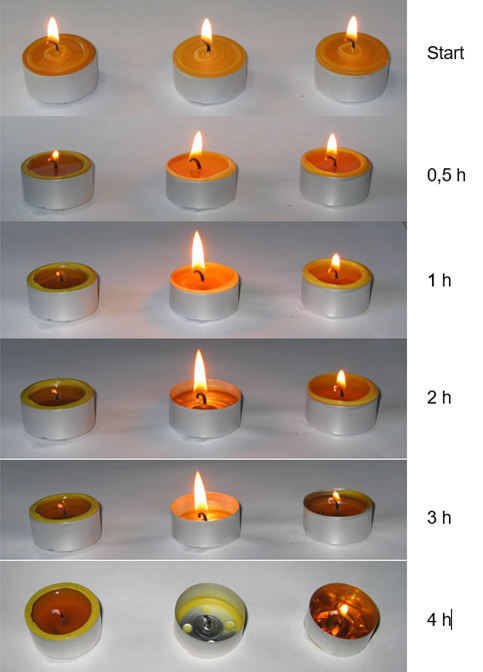
The burn test shown in the following image was carried out using different commercially available beeswax pastilles, which were stated to be filtered. Only the tea light in the center had completely burned after 4 hours, with the flame remaining at a consistent height throughout the entire burning time.
The tea lights on the left and right already showed poor burning behavior after 30 minutes and 1 hour, respectively (see image). The flame became smaller and eventually went out before all of the wax had been consumed.
Whether you buy beeswax or use your own wax for candle making is not the deciding factor, as long as the candles and tea lights burn well. Poor burning performance is caused by residues in the wax that can clog the wick after a short or longer period of burning.
Since a laboratory is usually not available for testing wax quality, a burn test (see image) is a practical way to assess wax purity. Performing a burn test with a large candle could take several days. For larger candles, the burning performance can often be improved by using a larger wick size.
For this reason, we always use tea lights for testing, as they react more sensitively to impurities in the wax and provide a faster indication of wax quality.
Waxes represent a distinct class of substances with specific properties. To work successfully with waxes, it is important to understand their structure as well as the different purification methods.
Would you like to gain a deeper understanding of waxes, beeswax, and beeswax purification? In my self-paced e-learning course with narrated presentations, you will learn:
the composition, structure, and characteristic properties of waxes as a distinct class of substances
the properties of different types of waxes
various beeswax purification methods
common mistakes during wax purification and their impact on candle performance