
Author: Dr. Andreas Kokott (About the Author)
To cast many molds quickly, larger quantities of liquid wax are required. It is therefore advisable to melt the wax in appropriately large containers as well. A good and, above all, cost-effective solution is to use a preserving or mulled-wine kettle. These kettles typically have a capacity of around 25 liters. When purchasing one, make sure that the heating elements are not visible when looking into the kettle, i.e. that they are located underneath the enameled base.
With a preserving kettle without a tap, the wax would have to be scooped out of the kettle. Mulled-wine kettles, however, are equipped with a tap (Fig. 1). This tap is not suitable for wax. If liquid wax cools and solidifies inside the tap, the resulting wax plug can no longer be removed easily.
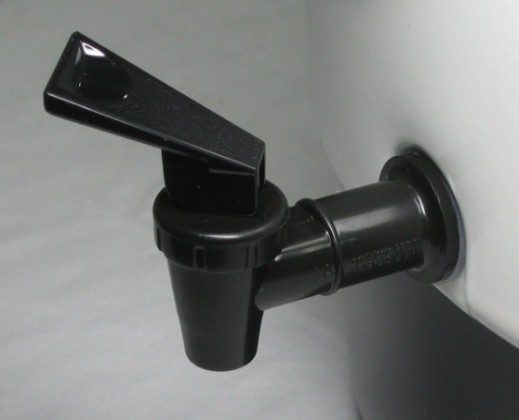
Fig. 1: Tap of a mulled-wine kettle
CAUTION: Modifying the kettle will void the warranty.
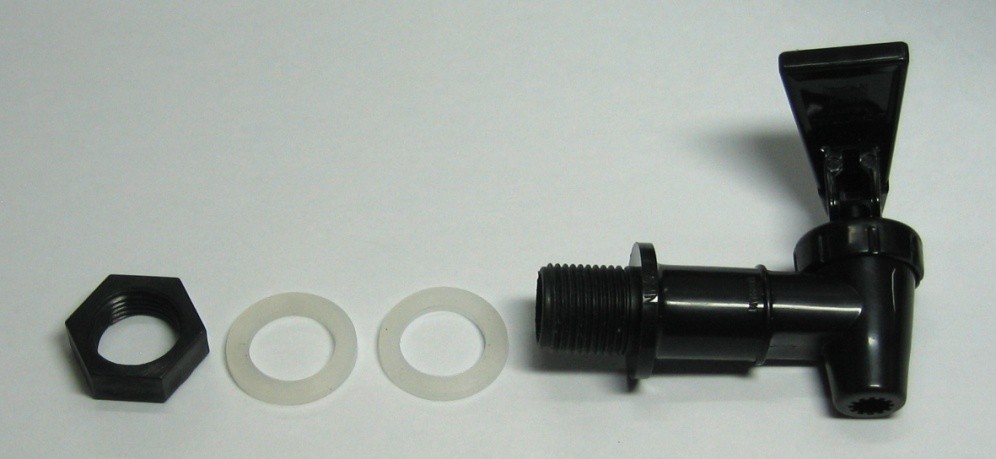
Fig. 2: Removed tap
To modify the kettle, the tap is removed. To do this, loosen the nut on the inside of the kettle and pull the tap (Fig. 2) out of the opening. The opening in the wall of the kettle has a diameter of 19 mm. The narrow end of the reducer (No. 4 in Fig. 4) must fit through this opening. Other solutions are also possible. We wanted to avoid enlarging the opening in the enameled metal by filing it out.
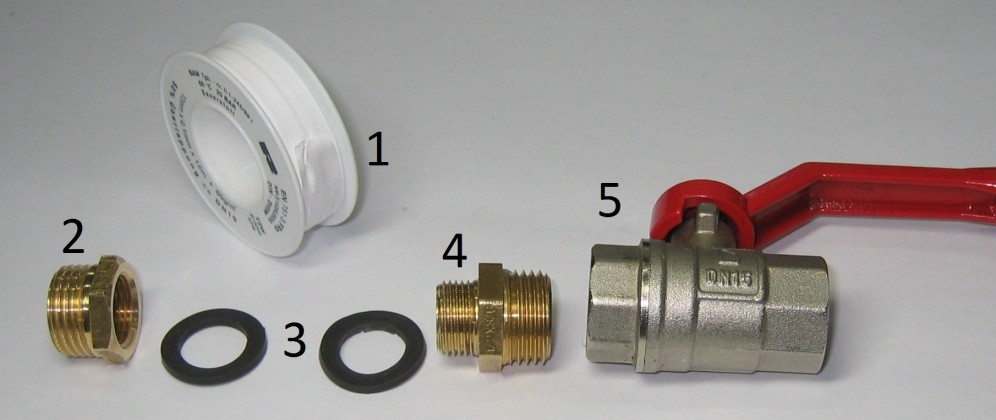
Fig. 3: Components for the conversion (1: sealing tape, 2: reducer, 3: gaskets, 4: double nipple, 5: ball valve)
The components required for the conversion (excluding tools) are shown in Fig. 3. We replaced the plastic gaskets that were too soft (white, Fig. 2) with more durable ones (black, Fig. 3).
The thicker thread of the double nipple is wrapped tightly several times with sealing tape. Using suitable wrenches (adjustable wrenches in this case), screw the reducer into the ball valve (Fig. 4).


Fig. 4: Reducer wrapped with sealing tape (left). Screwing the reducer into the valve (right).
The sealing ring is pushed over the thread and inserted through the opening into the kettle (Fig. 5). Inside the kettle, a section of the thread is visible. A sealing ring is then placed onto the thread, and the reducer is screwed onto it (Fig. 6). Using wrenches or similar tools (such as pipe wrenches), tighten the reducer so that the valve is securely fastened (Fig. 7).


Fig. 5: Thread with sealing ring (left), inserting it into the opening of the kettle (right).
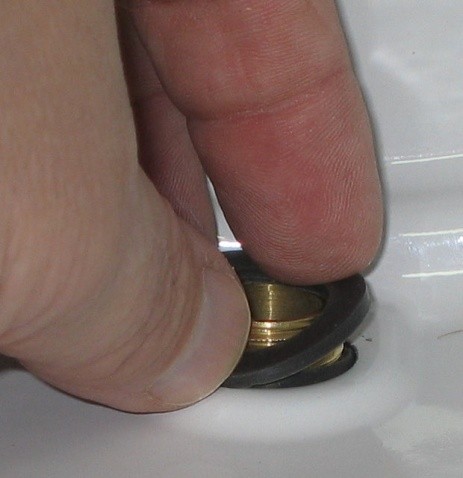

Fig. 6: Inside the kettle, placing the sealing ring over the thread (left), screwing on the reducer (right).
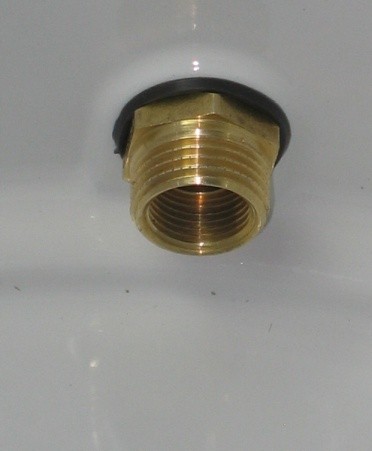
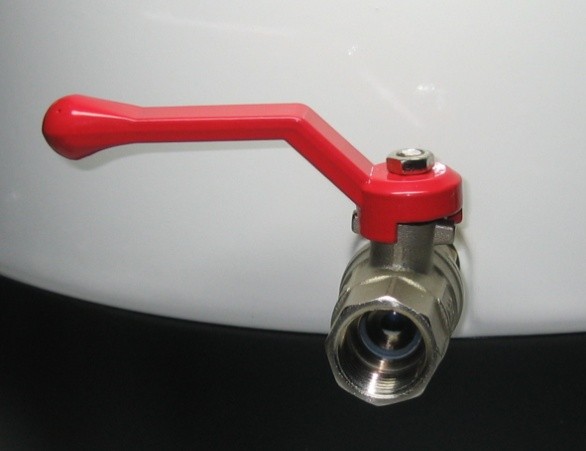
Fig. 7: View of the inside of the kettle (left) and the closed ball valve on the outside (right).
The thermostat (temperature control) on the kettle needs to be adjusted by trial and error. In our case, the control is set to 70 °C. Depending on the amount of wax, melting takes one to two hours. Before pouring, the temperature should be checked with a thermometer. Once you have found the optimum thermostat setting, you can melt and pour the wax quickly and efficiently.
Once the wax in the kettle has melted, the heat is usually not sufficient to keep the wax in the ball valve liquid as well. Place a container under the valve (Fig. 8) and use a stick (a wooden stick, Fig. 8) to push the plug of wax into the kettle. When the stick is removed, the wax will begin to flow out.
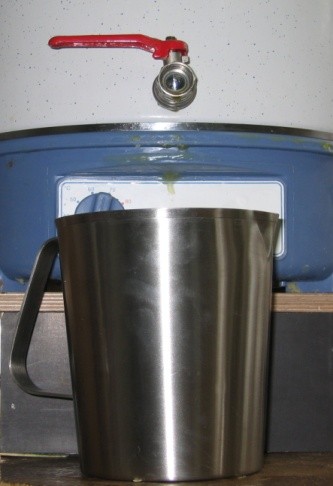
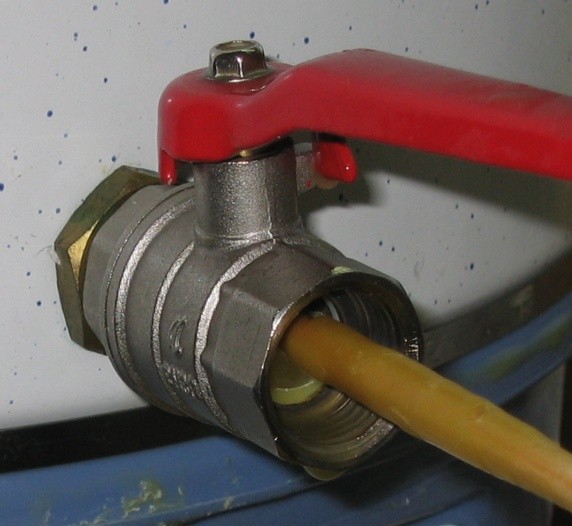
Fig. 8: Closed valve with container underneath (left), wooden stick inserted into the open valve (right).
The wax should always be transferred to a pouring jug first. It is not recommended to place the candle mold directly underneath the valve. A filled mold can easily spill over when being moved.
A mulled-wine kettle with a tap costs approximately €70–90. The components required for the conversion can be purchased for around €20–30. A sturdy table with a robust work surface should be an essential part of any candle workshop. For just a few euros, you can purchase a suitable wooden dowel and appropriately cut boards from a hardware store and screw them together to make a wooden box on which the kettle can be placed.