
Author: Dr. Andreas Kokott (About the author)
In every business, tasks arise every day and new ones are constantly added. When there are only a few employees—or none at all—a large part of the workload ends up on the entrepreneur’s desk.
Depending on the season, workload or day-to-day business, there may be more or less work on the table.
I have been running a small business for more than 20 years. This means I have fewer than 10 employees. So I know what it is like to have a desk that is constantly full of tasks.
The solution is simple, and I have been using it for several years.
I use what is known as the Eisenhower Method, 4-Quadrant Matrix or Priority Matrix. All you need is a pinboard or whiteboard, some sticky notes, and tape or a thick marker to create four fields.

The header row (column headings) and the row headings shown in the image are only included for clarification. In principle, we only need the four light-grey fields, as shown in the following image.

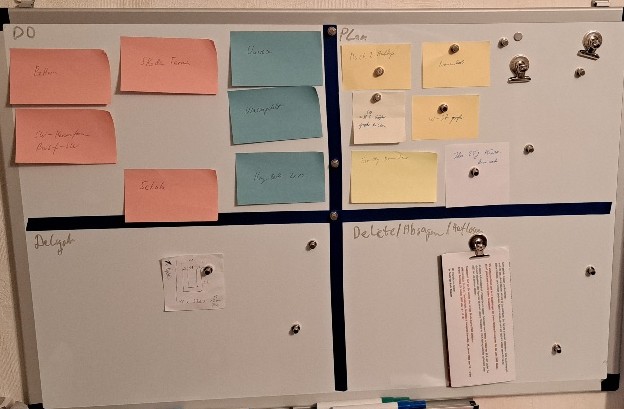
When tasks arise, I take a sticky note and write the task down. At the same time, I think about what will happen if the task is not completed today—or not completed at all. Based on this assessment, I then place the note in one of the four fields. If all tasks are assigned to one of the four fields, nothing gets forgotten. This can also be useful when you are unsure whether, for example, a task belongs in “Schedule” or “Delegate / Automate.” The important thing is: nothing gets lost.
You can also use different colored sticky notes. If the board is large enough, you can even use A4 folders, where you not only note the task but can also add the relevant documents. This means you do not have to store or search for documents in different places for a single task or process.
Let’s take a closer look at the individual fields. I will provide examples from the areas of trade businesses, retail, beekeeping and service providers. The four-field method can also easily be applied to private life.
Do immediately
This category is important for the financial success of the business. In other words, revenue may be lost or additional costs may arise. Failing to act in time will have a negative financial impact.
Example: Trade business
- A customer has made a complaint or a piece of equipment has broken down.
- Material is missing from a job site or the material is defective and needs to be replaced.
- A deadline for submitting a quotation is approaching.
Example: Retail business
- The checkout has stopped working and needs to be operational again the next day.
- The refrigeration system has failed, the goods need to be moved and the refrigeration system needs to be repaired.
- An important customer has requested a call back or sent an email about an urgent problem.
Example: Beekeeping
- A particular type of honey has been ordered in a large quantity. The order will be collected tomorrow and must be prepared today.
- A storm warning has been issued. The beehives need to be secured.
Example: Service business
- A customer has reported a software problem that needs to be resolved quickly.
- An employee has called in sick and a replacement needs to be arranged.
Schedule
These tasks are important for the long-term success of the business. The category is called “Schedule.” Simply placing a task in this field is therefore not enough. It needs a specific date and time. Only then is it truly planned.
For example: Order stock next Friday. Of course, this also means setting aside the necessary time on Friday to actually place the order.
What happens if you keep postponing these tasks? At some point, they move into “Do Immediately.”
If stock levels are low and you keep postponing the reorder, the task suddenly becomes urgent – especially if customers can no longer be supplied and you risk losing sales or customers.
Nothing is lost. A task that is important but not yet urgent does not disappear simply because it is postponed. It usually comes back later – often as a much more urgent and time-consuming problem.
Example: Trade Business
- Make changes to the website.
- Check incoming payments and remind customers with overdue payments.
- Select and order tools.
- Create a notice for holiday planning.
Example: Retail Business
- Place orders.
- Compare suppliers.
- Review competitors’ offers.
- Adjust the store decoration.
Example: Beekeeping
- Order containers.
- Inspect the bee colonies.
- Bring the bees back from one of the locations.
Example: Service Business
- Adjust the range of services.
- Commission an advertisement.
- Suggest annual consultation appointments to existing customers.
Delegate / Automate
I have expanded the original category “Delegate” to include “Automate.” If you have no employees, there is no one internally to whom you can delegate tasks. Recurring tasks can, however, be automated, simplified or outsourced.
- Create optimized templates or forms for recurring tasks that are prone to errors.
- Set up automated payment reminders.
- Automate reordering based on inventory levels.
- Transfer responsibility to a team leader (e.g. in a trade business).
- Create price lists, for example for resellers, so that a new list does not have to be created every time there is an inquiry.
- Create templates for new channels or newsletters.
- Create an FAQ.
- Regularly outsource deliveries to a service provider.
Delete / Cancel
What is neither important nor urgent is a thief. It steals time, money and attention without bringing any real benefit to the business.
Of course, not every small task belongs in this category. You delete a spam email as soon as it arrives, and unwanted advertising goes straight into the recycling bin. The Eisenhower Matrix is not intended to sort every single activity. It is primarily a tool to help you consciously decide what you do not need to do at all.
- So what belongs in this field?
- Canceling attendance at an event if it has become clear that it no longer offers sufficient value to the business.
- Canceling a subscription, for example an advertisement in a magazine that does not generate any customers.
- Turning down a job inquiry if the risk is too high, the job cannot be calculated reliably, or it does not fit the business.
- Dropping a planned activity that does not make a meaningful contribution to the business.
- Discontinuing a sales channel or advertising campaign if the time and costs consistently outweigh the benefits.
- Canceling an event, appointment or project if circumstances have changed and the original reason for doing it no longer exists.
Learn more: Find e-books and more blog articles here: